Your Business Runs on 101 Apps. That Is the Problem.
The average company now runs 101 different apps. Here is what that fragmentation costs in real hours every week, and what a Business Operating System does about it.
Here is a milestone nobody celebrated. According to Okta's Businesses at Work 2025 report, which analyses anonymised data from thousands of organizations, the average company now uses 101 different software applications. The number sat near 90 for years. It has now crossed one hundred.
Each of those apps was bought to solve a problem. Together, they created a new one.
Your CRM does not talk to your project tool. Your project tool does not talk to your invoicing. Your invoicing does not talk to the spreadsheet where the real numbers live. So your people become the integration layer. They copy, they paste, they export, they reformat, and they chase each other for the version that is actually current.
The cost of this is not a feeling. It has been measured. Researchers writing in Harvard Business Review tracked 137 employees across three Fortune 500 companies and found that the average worker toggled between apps and windows roughly 1,200 times a day. Those switches added up to just under four hours a week spent purely reorienting, around 9 percent of total working time. Not working. Reorienting.
And that is only the switching. McKinsey Global Institute found that the average interaction worker spends nearly 20 percent of the working week looking for internal information or tracking down the colleague who has it. Call it a full day, every week, spent searching for work instead of doing it.
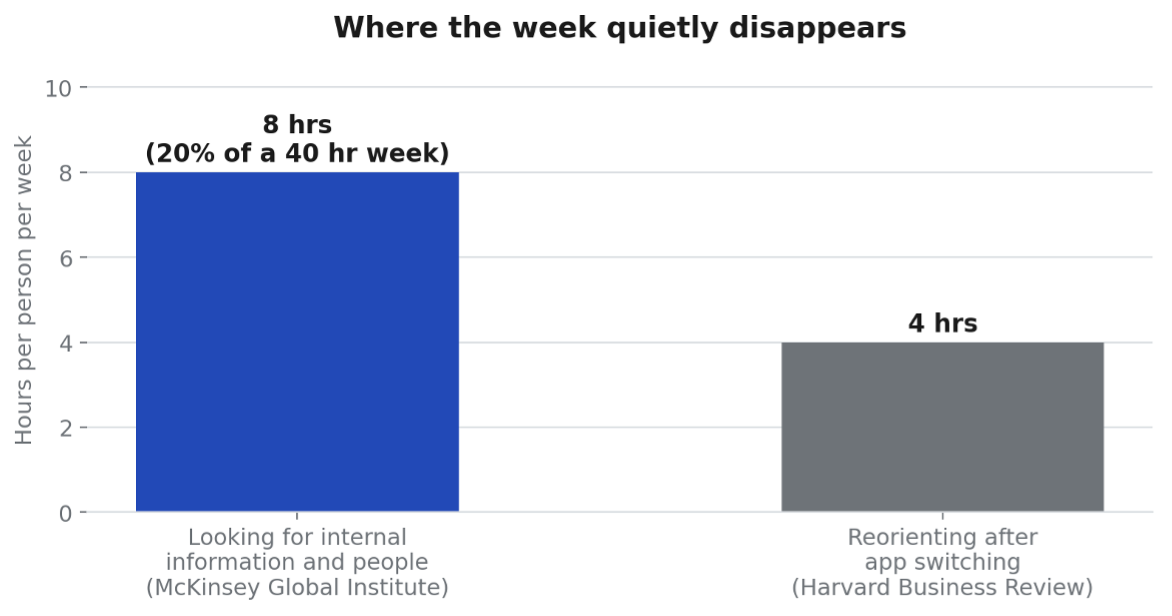
Figure 1. Weekly hours lost per knowledge worker, based on a standard 40 hour week. Sources: McKinsey Global Institute, The Social Economy; Harvard Business Review, 2022.
Add it up for a team of twenty and you are paying several full salaries for work that produces nothing. No customer sees it. No invoice reflects it. It is pure internal friction, and it grows with every tool you add.
The hidden invoice nobody signs
Fragmentation never shows up as a line item. It shows up as symptoms. Deals stall because nobody updated the pipeline. A client asks a simple question and three people spend an afternoon assembling the answer. The month closes late because finance is reconciling numbers from five sources. A key employee resigns and half your processes resign with them, because those processes only ever existed in their head and their inbox.
You did not choose any of this. It accumulated, one reasonable purchase at a time.
What a Business Operating System actually is
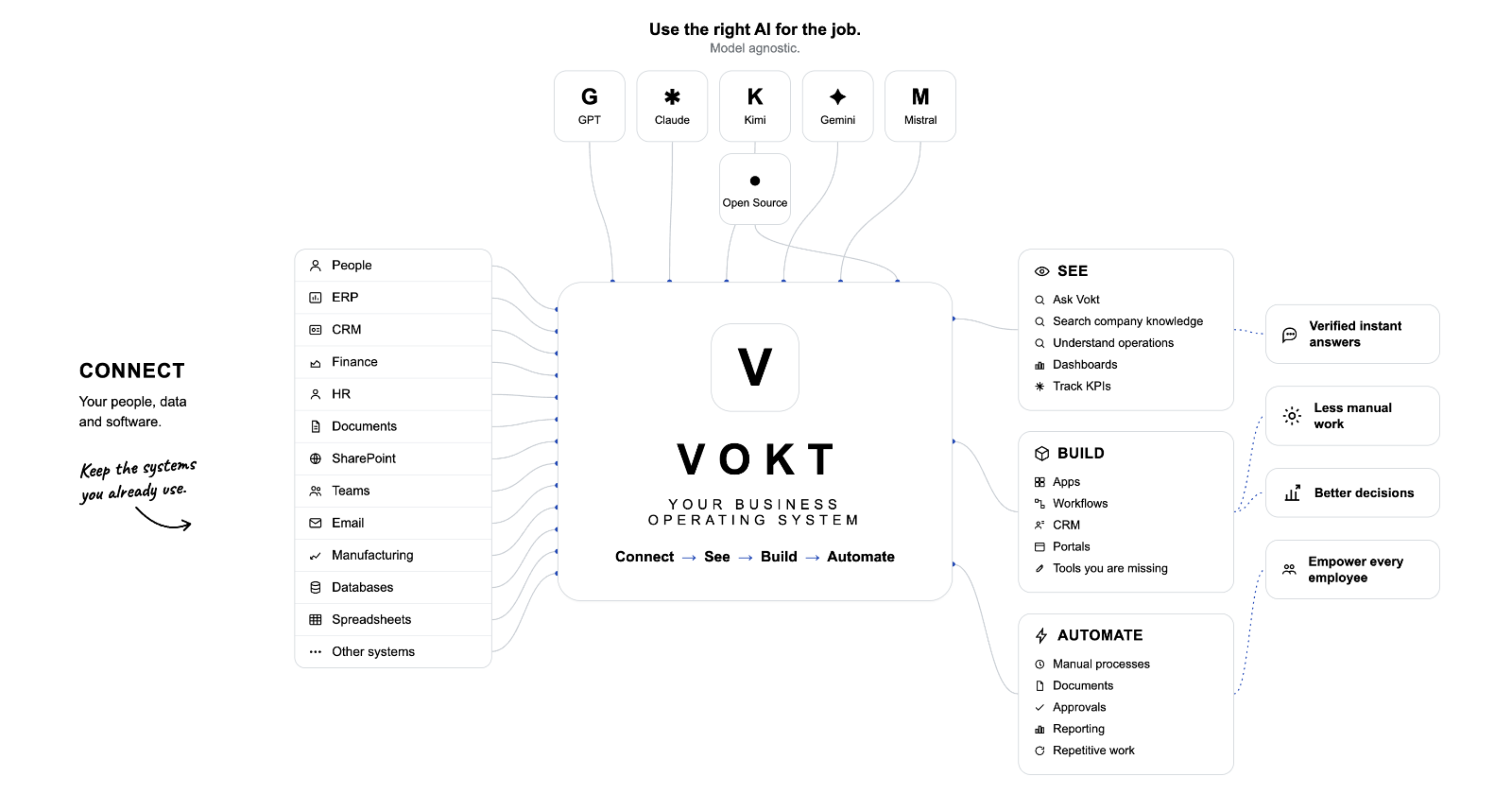
A Business Operating System is not another app on the pile. It is the layer where your operations live in one place. Your customers, your projects, your documents, your numbers, your processes.
This is what we built Vokt to be, and the logic runs in a fixed order. First you see everything in one view instead of eleven tabs. Then you build the way your company actually works into the system, so the process exists in the business rather than in someone's memory. Then you automate the repetitive parts, so the copying and the chasing stop.
See. Build. Automate. In that order.
A point solution adds capability and adds fragmentation at the same time. An operating system removes fragmentation. That is the entire point of it.
The question worth asking
Count your tools. Not the ones IT knows about. All of them, including the spreadsheets quietly doing jobs that software should do. If the number surprises you, ask the harder question. How much of your team's week is spent serving those tools instead of serving customers?
You already know the answer is too much. The only real decision is how long you keep paying for it. When you are ready to stop, see what one system looks like at vokt.ai.
Sources
Okta, Businesses at Work 2025. https://www.okta.com/newsroom/articles/businesses-at-work-2025/
Murty, Dadlani and Das, How Much Time and Energy Do We Waste Toggling Between Applications, Harvard Business Review, August 2022.https://hbr.org/2022/08/how-much-time-and-energy-do-we-waste-toggling-between-applications
McKinsey Global Institute, The Social Economy: Unlocking Value and Productivity Through Social Technologies, 2012. https://www.mckinsey.com/industries/technology-media-and-telecommunications/our-insights/the-social-economy