How to Stop Running Your Company From Spreadsheets
Field audits show 88 percent of operational spreadsheets contain errors. Five signs you have outgrown Excel, and how to make the move without breaking anything. Cover: Figure 2 chart, or a spreadsheet cell highlighted in red.
Spreadsheets are the most successful business software ever made. They are also where growing companies go to plateau.
Professor Raymond Panko at the University of Hawaii has spent decades studying spreadsheet quality. His review of field audits conducted since 1995, where researchers examined real operational spreadsheets inside real companies, found that 88 percent of the 113 spreadsheets audited contained errors. Not badly built ones. Normal ones, made by competent people. A formula copied one row too far, silently wrong for months.
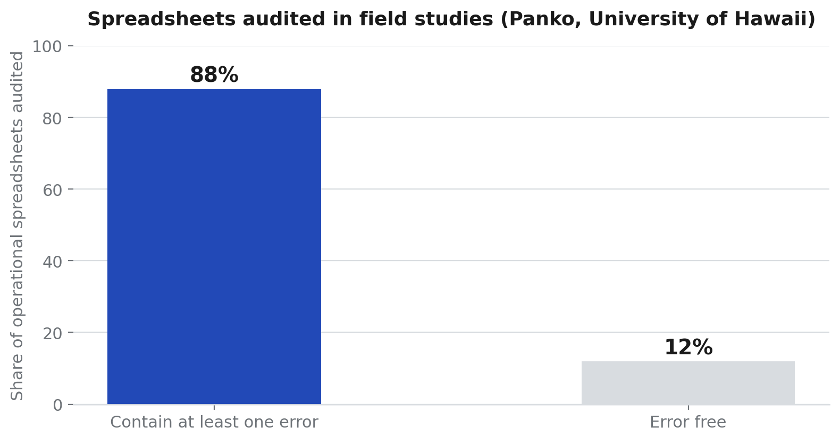
Figure 2. Field audits of operational spreadsheets since 1995. Source: Panko, What We Know About Spreadsheet Errors, University of Hawaii.
Some spreadsheet errors made history. In 2003, the Canadian power company TransAlta lost 24 million dollars because of a copy and paste mistake in a bidding spreadsheet. In 2013, researchers at the University of Massachusetts found that a famous Harvard economics paper by Reinhart and Rogoff, used to justify austerity policy across Europe, excluded five countries from a key calculation because of an Excel range error. If economists advising governments get cells wrong, so does your operations manager.
But errors are not even the biggest cost. The biggest cost is that a spreadsheet is a snapshot, and your business is a moving picture.
Five signs you have outgrown Excel
One. There are multiple versions of the truth. The file is called final_v3_UPDATED and nobody is certain it is actually final.
Two. One person owns the sheet. When they are on holiday, that part of the business is on holiday too.
Three. The first ten minutes of every meeting go to establishing what the numbers are, instead of deciding what to do about them.
Four. Data gets typed in twice. Once into the tool where it happened, once into the sheet where it gets reported.
Five. Nothing tells you when something changes. A spreadsheet never taps you on the shoulder. It waits for you to open it, and by then the moment has often passed.
How to actually make the move
Start with the sheet that hurts most. Not the biggest one. The one causing arguments, delays or errors. Usually it is the pipeline sheet, the project tracker or the resource planner. Move that one first and let the win build appetite for the next.
Map the process before you move the data. Every long lived spreadsheet encodes a process nobody wrote down. Columns are steps. Tabs are handoffs. Colour coding is somebody's private status system. Write down what the sheet actually does before you rebuild it, or you will rebuild the confusion along with it.
Move it into a system where the data is alive. This is exactly what a Business Operating System like Vokt is for. A record updates once and everyone sees it. There is no version. There is only the current state, visible to everyone who needs it.
Keep spreadsheets for what they are good at. Modelling. Scenarios. Analysis. Excel is brilliant as a calculator. It was never meant to be your company's memory.
Retire the old sheet publicly. This is the step most teams skip. If the sheet stays available, people drift back. Announce the switch, archive the file, and make the new system the only place the answer exists.
What you get back
The payoff is not dramatic on day one. It compounds. Fewer errors, because data is entered once at the source. Faster meetings, because the status is already known. Real handovers, because processes live in the system instead of in one person's head. And a business you can actually see, live, instead of one you reconstruct every Friday afternoon.
The spreadsheet got you here. It is not what gets you there. When you are ready to move the first sheet, start at vokt.ai.
Sources
Panko, R., What We Know About Spreadsheet Errors, University of Hawaii. http://panko.shidler.hawaii.edu/SSR/Mypapers/whatknow.htm
TransAlta spreadsheet loss of 24 million dollars, 2003, as reported by The Register and Reuters.
Herndon, Ash and Pollin, Does High Public Debt Consistently Stifle Economic Growth, University of Massachusetts Amherst, 2013, documenting the Reinhart and Rogoff Excel error.